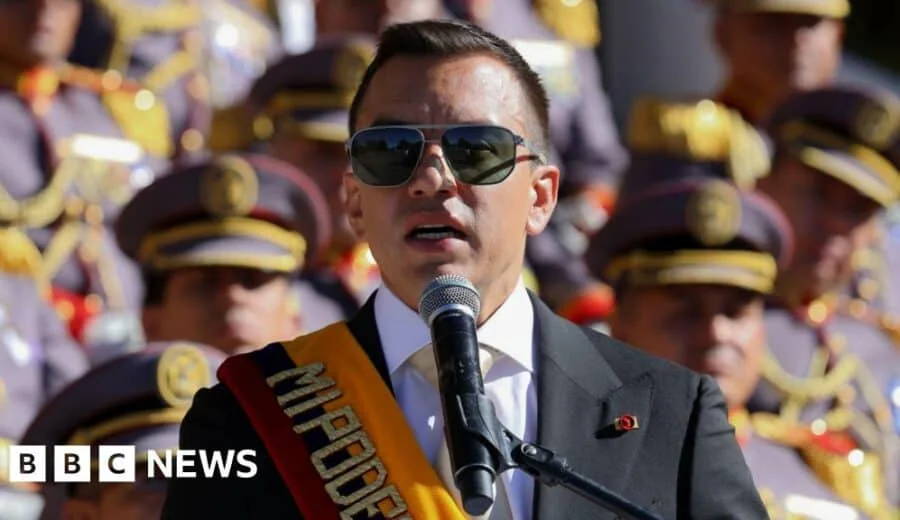
Colombia’s foreign ministry has accused Ecuador’s president, Daniel Noboa, of “deliberate interference” in the country’s upcoming presidential election, scheduled for Sunday. Noboa promised to lift tariffs on Colombian products in a meeting with right-wing candidate Abelardo de la Espriella, sparking outrage from Colombian officials. The move is seen as an attempt to influence the outcome of the election, which could have significant implications for the country’s alliances and approach to tackling drug violence.
The controversy began when Noboa met with de la Espriella on Friday, framing their conversation as a discussion between an administration-in-waiting and a foreign leader. Noboa announced that he would drop Ecuador’s tariffs on Colombian products as of June 1, citing an agreement with de la Espriella on trade and security. However, Colombia’s foreign ministry criticized the move, calling it a “flagrant violation of the principle of non-intervention in internal affairs” and a threat to national sovereignty.
Colombian Election Interference
The election in Colombia is highly polarized, with the outcome potentially redefining the country’s relationships with other nations and its approach to addressing drug-related violence. Left-wing President Gustavo Petro, who is unable to seek re-election, has clashed with US President Donald Trump on issues including drug trafficking and American intervention in the region. De la Espriella, who is seen as a close ally of Trump, has taken a hardline stance on drug violence and joined a US-led alliance to combat cartels.
Ecuador has imposed tariffs on Colombian imports since January, citing concerns over the country’s ability to secure their shared border. The move has been seen as a response to Colombia’s perceived failure to address the flow of cocaine through the region. Ecuador’s geographical location, sandwiched between Colombia and Peru, has made it a key transit country for the illicit drug.
The election in Colombia has been marked by violence, with one candidate fatally shot last summer and de la Espriella appearing at a rally behind bulletproof glass. The candidates have campaigned on opposing platforms, with some vowing to launch a military crackdown on drug gangs and others promising to continue Petro’s policy of “total peace” through negotiated settlements.
Implications and Reactions
The interference by Ecuador’s president has been met with outrage from Colombian officials, who see it as an attempt to sway the outcome of the election. The move has also sparked concerns over the potential for other foreign leaders to intervene in the democratic process. The US has a significant stake in the outcome of the election, with Trump having revived the Monroe Doctrine and indicated a willingness to intervene in the region.
The outcome of the election will have significant implications for the region, with the potential to shift alliances and approaches to addressing drug violence. As one of the few remaining left-wing leaders in the region, Petro’s successor will face significant pressure to navigate the complex web of relationships between Colombia, the US, and other nations in the region.


