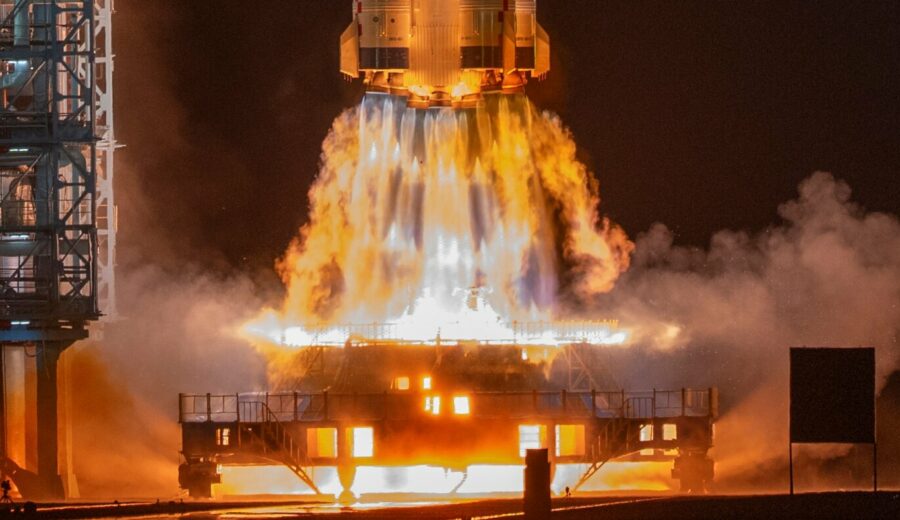
China launched the Shenzhou 23 spacecraft on Sunday, sending three astronauts to its space station, with one set to stay in space for a record-breaking year.
The spacecraft blasted off from the Jiuquan Satellite Launch Center in northwestern China, carrying astronauts Zhu Yangzhu, Zhang Zhiyuan, and Lai Ka-ying on a mission to conduct dozens of science and application projects.
Space Station Mission
The crew is expected to complete an in-orbit rotation with the crew of Shenzhou 21, who have been at the Tiangong space station for over 200 days, and one of the astronauts will stay at the orbiting space station for a year to explore human adaptability and performance limits in long-duration spaceflight environments.
The mission marks a significant step for China’s space program, which has been developing rapidly in recent years, with the Tiangong space station first hosting a crew in 2021.
China’s space program has been driven in part by its exclusion from the International Space Station due to US concerns over national security, and the country is now seen as a major competitor to the US in space exploration.
Implications for Space Exploration
The launch of the Shenzhou 23 spacecraft comes as China prepares for its first crewed lunar landing by 2030, and the US aims to land astronauts on the lunar surface in 2028, setting the stage for a new era of space competition between the two nations.
The success of the Shenzhou 23 mission will have significant implications for the future of space exploration, as countries around the world push the boundaries of what is possible in space, and the yearlong mission will provide valuable insights into the effects of long-term space travel on the human body.
The launch of the Shenzhou 23 spacecraft is a major milestone in the history of space exploration, and its success will have far-reaching implications for the future of space travel and the pursuit of scientific discovery.


