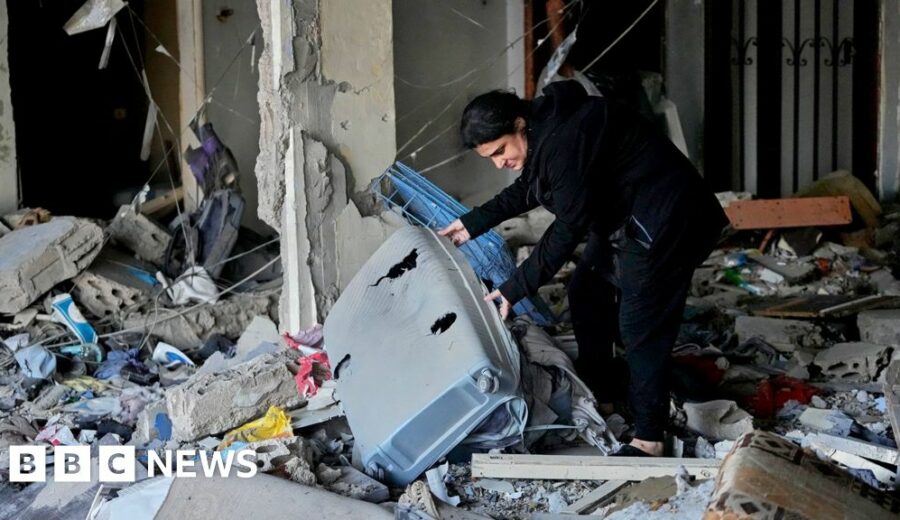
Israeli forces have launched heavy strikes on southern Lebanon, hitting the city of Tyre and surrounding areas, with reports of widespread destruction and civilian casualties. The Israeli military targeted Hezbollah infrastructure, according to officials, with waves of strikes hitting the region. Social media videos show dust-covered crowds of people gathered around collapsed buildings in Tyre.
The Israel Defense Forces (IDF) had urged residents to move north of the Zahrani River, about 40km from the Israeli border, warning that it would act “with extreme force”. Two sets of Israeli strikes hit Tyre and an area to the city’s east on Thursday morning, with footage capturing explosions and fires burning through the night and into Thursday morning. At least one vehicle was engulfed in fire, and a massive fireball was filmed erupting near a cluster of high-rise residential buildings.
Lebanon Conflict Escalation
The strikes come after Israeli Prime Minister Benjamin Netanyahu announced an expansion of its ground operation following Hezbollah drone attacks on troops occupying part of southern Lebanon and on civilians in northern Israel. The escalation has led to a large-scale evacuation, with shelters in the city of Sidon reaching full capacity and residents advised to travel further north to the capital, Beirut. The head of the International Committee of the Red Cross (ICRC) delegation in Lebanon warned that the situation in the country’s south was “nearing a perilous tipping point”.
Hezbollah said its fighters had clashed with Israeli forces “at point-blank range” in Zawtar al-Sharqiyeh, north of the Litani River, which lies outside the Israeli-declared “buffer zone”. The conflict has strained the wider region, with an Israeli drone strike hitting a family trying to flee threatened villages in southern Lebanon, killing six people, including children. The scale of displacement is now straining the region, with many residents having nowhere to go.
Regional Implications
The escalation threatens to derail talks aimed at ending the war between the US and Israel on one side and Iran on the other. Iran insists that any deal must address its concerns, while Israeli officials have said Hezbollah’s attacks are violating the temporary ceasefire deal between the Israeli and Lebanese governments. The situation remains volatile, with both sides accusing each other of repeated violations of the ceasefire.
The conflict has significant implications for the region, with the potential to draw in other countries and lead to further instability. The international community is watching the situation closely, with many calling for a peaceful resolution to the conflict. As the situation continues to unfold, it is clear that the conflict in southern Lebanon has far-reaching consequences, affecting not only the region but also global stability.


